

Patches of dark, exceptionally fertile soil are scattered across the Amazon Basin along river bluffs and ancient pathways, in a landscape where the surrounding soil is aluminum-toxic, severely leached, and low in soil carbon. Indigenous Amazonians built these soils, terra preta do índio, primarily between 500 BCE and 950 CE. They are estimated to cover on the order of 150,000 km² today (roughly 3% of the Amazon basin) and hold organic carbon levels double those of adjacent soils, along with rich reserves of phosphorus, calcium, magnesium, manganese, and zinc. These soils have persisted in fecundity for one to two thousand years after active management ended.
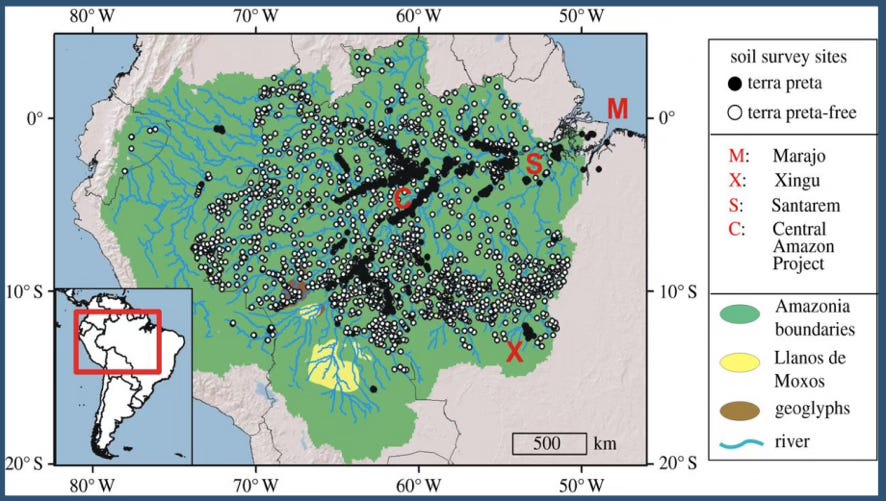
Historically, this is unusual. Most agricultural civilizations leave behind degraded soil, and in many cases, this drove their collapse. Modern agriculture is on the same trajectory. Terra preta is one of the rare cases where farming built rather than depleted the soil it depended on. That’s why it sits at the center of contemporary discussions of biochar, the modern term for charcoal-amended soil.
The success of terra preta has shaped how biochar is seen today. Promoted as a climate solution, an amendment for any soil, and a regenerative agriculture cornerstone, biochar has been pulled into more contexts than it deserves and applied in ways that bear little resemblance to the conditions under which it actually performs. Across hundreds of greenhouse and field trials, average yield response is just 2.8%, and roughly three out of four trials show no statistically significant difference. Yet in specific contexts — acidic tropical soils, sandy soils with poor retention, heavy metal contamination, perennial systems with on-farm biomass — the same material produces yield increases of 30 to 75 percent alongside durable soil improvements that persist for decades. The gap is the predictable consequence of selling a context-dependent technology as a universal one.
How Terra Preta Formed
The story of biochar begins in the pre-Columbian Amazon and was first brought to modern scientific attention in the 1950s by Dutch soil scientist Wim Sombroek, who encountered patches of remarkably dark, fertile soil scattered through the rainforest during field surveys. How they formed is more specific than the modern biochar story usually acknowledges.
The prevailing theory is that pre-Columbian Amazonians employed slash-and-char rather than slash-and-burn — cutting plant material, igniting it, then smothering it before complete combustion to produce charcoal rather than ash. This isolated most of the carbon from the original vegetation as a stable, porous amendment rather than releasing it as CO₂ and ash. But the soils benefited from more than just charcoal. Ceramic shards, fish and manatee bones, and organic refuse consistently found in terra preta horizons indicate these sites were also kitchen middens or refuse heaps that accumulate around long-occupied habitation areas. Charcoal from cooking fires built up alongside food waste, bone meal, manure, and human excreta over centuries. A typical terra preta horizon contains roughly 9% organic carbon, much of it pyrogenic — carbon transformed by fire into fused aromatic ring structures that resist microbial decomposition — compared to 0.5% organic carbon in adjacent soils. The high phosphorus and calcium loads come from bone and biological waste streams rather than from the char itself.
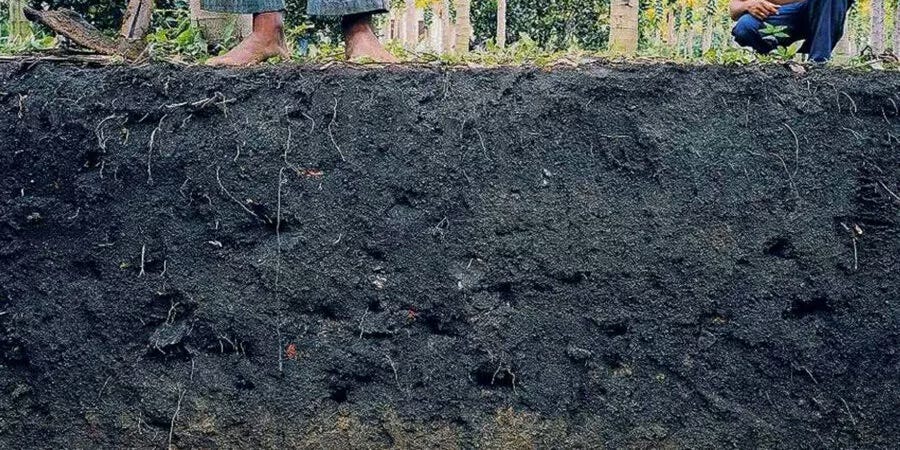
Terra preta is also frequently found alongside terra mulata, lighter brown anthropogenic soils that ring the darker patches and appear to represent areas of cultivation rather than habitation. The two soils together suggest an integrated land-use pattern: dense settlement at the core, intensive cropping at the perimeter, with both gradually building soil over generations. A 2018 study documented that polyculture agroforestry systems in eastern Amazonia intensified alongside dark earth development after approximately 2,000 years before present, leaving a measurable enrichment legacy in modern forest composition. The dark earths and the managed forests around them appear to be two facets of the same long-running system.
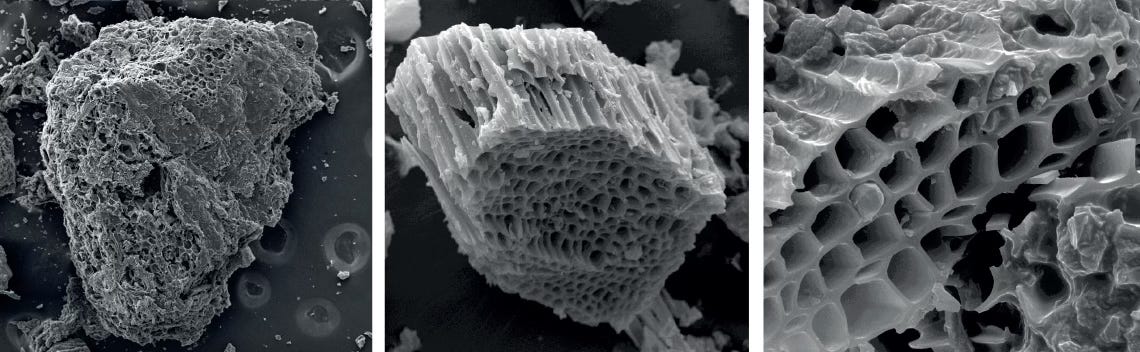
The persistence of these soils stems from the molecular structure of pyrogenic carbon. As biochar ages it physically disintegrates into smaller particles that migrate downward into soil compartments where decomposition is further inhibited. Conservative estimates indicate that the majority of biochar carbon remains in storage after a century, and radiocarbon work suggests that some biochar can persist on an even longer timescales. Terra preta also exhibits a unique self-regenerating quality. There are documented accounts of Amazonian farmers excavating terra preta for sale as potting soil, with the patches gradually reforming over decades — the result, researchers suspect, of microbial communities and soil structure that, once established, continue to draw in and stabilize new organic inputs.
The civilizational implications are one of the most interesting aspects of this research. Pre-Columbian Amazonia is now estimated to have supported between 5 and 10 million people at European contact, with archaeological modeling pointing to local densities of more than ten persons per square kilometer along some of the seasonally flooded riverine forests of the Amazon — substantially higher than typical modern rural forest densities in comparable terrain. After European contact, epidemic disease and colonization caused a population collapse that left these dark earths behind, still productive, beneath returning forest.
Temperature, Feedstock, and Time
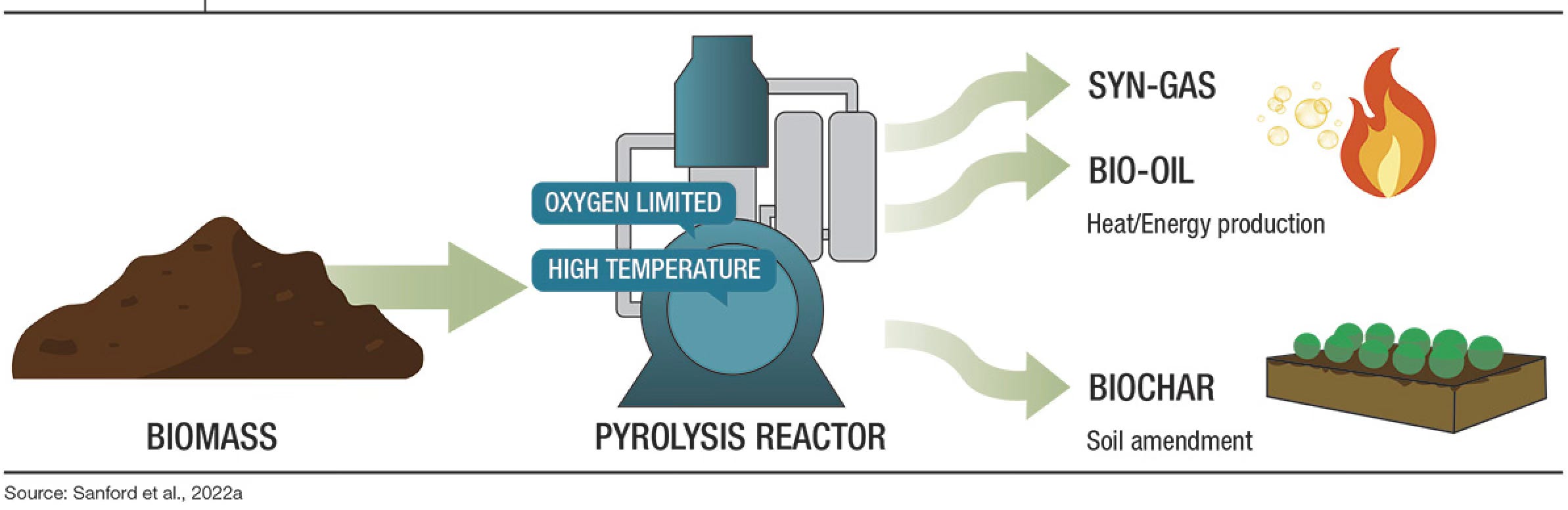
Modern biochar production relies on pyrolysis — thermochemical decomposition of biomass at 400–700°C in oxygen-limited conditions. The specific conditions employed determine almost every property that matters agronomically. Lower temperatures (300–400°C) produce biochars with higher volatile matter content, more surface functional groups, and greater cation exchange capacity, but potentially more phytotoxic compounds. Higher temperatures (500–700°C) yield biochars with greater surface area, higher carbon content, increased pH, and improved long-term stability — at the cost of reduced nutrient content and reduced CEC.
Feedstock matters as much as temperature. Comparative trials show nutrient-rich feedstocks like poultry litter can sharply raise soil CEC. Woody biochars usually don’t rain pH, and in some cases lower it. Manure- and sludge-derived biochars carry higher nutrient loads but also higher polycyclic aromatic hydrocarbon (PAH) and heavy metal concentrations. Woody feedstocks produce cleaner chars with lower nutrient density. “Biochar” as a generic input category is nearly meaningless. Specifying feedstock, peak pyrolysis temperature, and post-production handling is the minimum information required to predict agronomic behavior.
After incorporation, biochar moves through three distinct phases. The first one to three weeks release soluble components — ash minerals, organic acids, and any volatile organic compounds adsorbed during pyrolysis. Over the following one to six months, surfaces progressively oxidize, generating the carboxyl and hydroxyl functional groups that build cation exchange capacity. Beyond six months, biochar enters extended aging, integrating into soil aggregates and developing tighter bonds with native soil organic matter. Aged biochar typically shows enhanced nutrient retention, improved heavy metal immobilization, and stronger trial performance than fresh material. Studies terminated after a single growing season often miss the response that emerges in years two through five.
Matching Biochar to the Constraint
The strongest case for biochar appears in soils where its properties directly address a limiting constraint.
Acidic tropical soils, where biochar originated, remain the clearest application. Meta-analyses consistently show the largest crop yield responses (up to 42%) on low-nutrient, phosphorus-sorbing acidic soils. Several reinforcing effects operate together. Biochar’s alkalinity neutralizes soil acidity, with applications reducing acidity by over 50% in some studies. It increases phosphorus availability by an average factor of 4.6 in P-fixing tropical soils. Raising pH reduces aluminum solubility and root toxicity. And its porous structure provides habitat for mycorrhizal fungi.
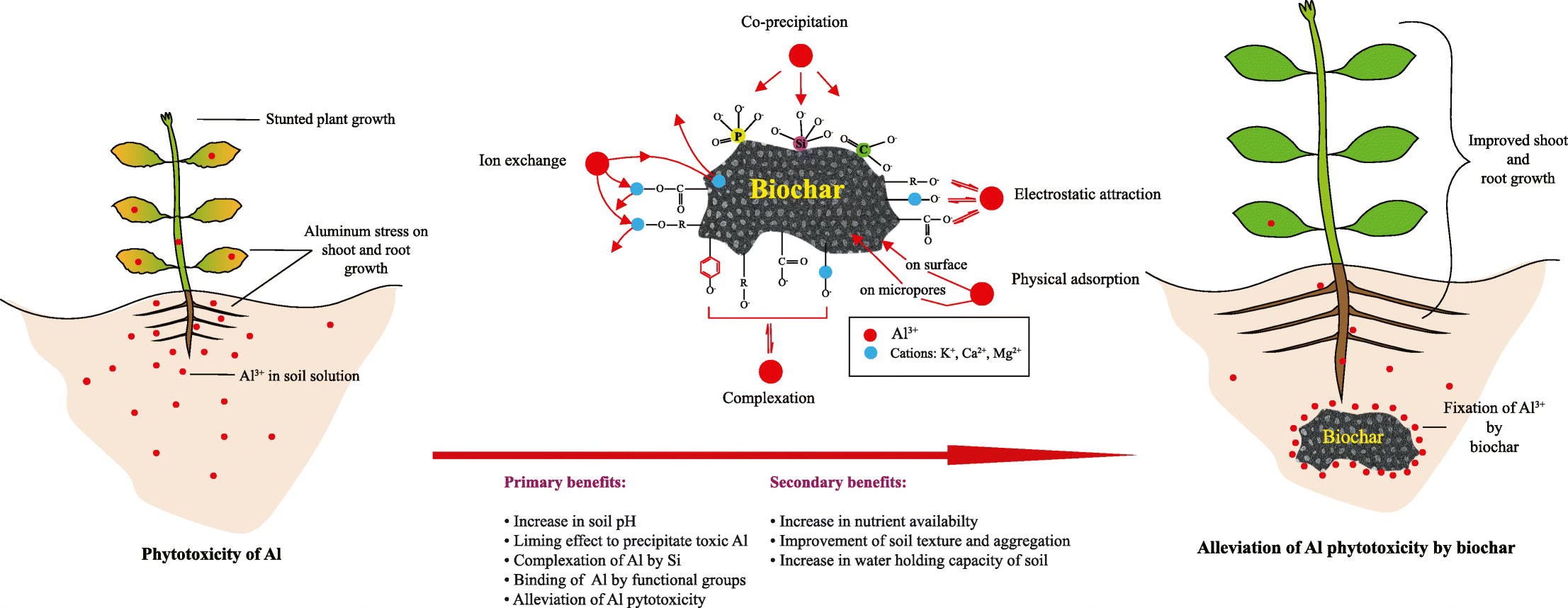
Sandy soils are a second strong use case, particularly in perennial systems with on-farm biomass streams. A study on Valencia orange in the sandy soils of El Salheya, Egypt — 94.7% sand content, severely leached, with available potassium below 0.21 ppm — provides a useful concrete example. Biochar produced from citrus pruning waste, applied at 6 kg per tree annually, increased yields by 73.3% and 67.9% in the first and second seasons respectively, with clear dose-response (2 < 4 < 6 kg/tree). Each effect fed the next. Improved nutrient retention raised leaf nitrogen by 18.7%, phosphorus by 22.5%, and potassium by 35.4%. Better foliar nutrition raised chlorophyll content by 16.3%. Enhanced photosynthesis produced 12–18% increases in fruit total soluble solids and ascorbic acid. None of this is unique to biochar — but in a sandy soil under drip irrigation where nutrients leach below the root zone between fertigation events, biochar’s role as a buffering matrix is what allowed each step in the cascade to function. The same intervention applied to a high-CEC clay loam would have done little, because the limiting constraint there is different. Biochar excels where it matches a soil’s limiting constraint, which is less often than the marketing suggests.
Heavy metal contamination is a third constraint biochar matches well. Engineered biochars have demonstrated immobilization of chromium, cadmium, nickel, mercury, and other contaminants through surface adsorption, pH-mediated precipitation, and complexation with oxygen-containing functional groups. Aging improves rather than degrades immobilization capacity as surface oxidation generates additional binding sites.
The Common Mismatches
Already-alkaline soils are the most obvious mismatch. Most biochars carry alkalinity, and applying them to soils above pH 7.5 risks pushing iron, zinc, manganese, and copper availability below crop requirements. The International Biochar Initiative explicitly recommends pre-screening soils based on pH and avoiding application above 7.5 unless using acidified or low-temperature biochars formulated for those conditions. In high-organic-matter loams and Mollisols, the functions biochar provides — cation exchange capacity, microbial habitat, water retention, carbon storage — are largely redundant. Resources spent on biochar in productive midwestern row crop systems return less than the same dollars invested in cover cropping or extended rotations.
Application rate is where the gap between marketing and science is widest. Research-backed rates fall in the range of 5–50 tonnes per hectare. Iowa State soil scientist David Laird has criticized commercial claims promising 12–15% yield increases from 15–20 pounds of biochar per acre — rates roughly five hundred times below the levels at which meaningful effects have been documented. Across 507 trials examined in one analysis, only 22% showed statistically significant positive yield responses, 4% showed significant negative responses, and 74% showed no statistically significant difference. The aggregate average response of 2.8% reflects a literature dominated by underdosed applications on inappropriate soils.
Two further cautions deserve mention. Biochar’s adsorption capacity binds herbicides as readily as it binds nutrients; trials have documented substantial reductions in herbicide efficacy on biochar-amended soils. Given biochar’s residence time of centuries to millennia, this is a permanent agronomic consequence. Contamination during pyrolysis is also a real concern. PAHs, VOCs, dioxins, and heavy metals can be introduced or concentrated, particularly with sewage sludge or poultry manure feedstocks, and particularly in pyrolysis units with poor heat distribution or vapor management.
How Biochar's Carbon Differs
Biochar is frequently promoted alongside cover cropping, no-till, composting, and adaptive grazing as a soil-based carbon sequestration strategy, often as the most durable of them. Each of these practices stores carbon differently, and treating them as interchangeable obscures both biochar's genuine advantages and its real limits.
Two large studies pooling trials from around the world provide the clearest data on cover cropping. Poeplau and Don's 2014 synthesis estimated annual sequestration at 0.32 ± 0.08 Mg C/ha/yr, with carbon accumulating linearly toward a modeled steady state after roughly 155 years. A 2020 update from Jian and colleagues, drawing on a larger global dataset, estimated 0.56 Mg C/ha/yr. The caveats matter. About a quarter of the comparisons in the 2020 synthesis actually showed cover crops decreasing soil organic carbon. Gains are concentrated in the upper 30 cm of the profile. And accumulation depends on continued practice. Stop cover cropping, and the carbon mineralizes back to atmospheric CO₂ over years to decades.
No-till produces more modest and more contested gains. Apparent topsoil carbon increases under no-till frequently disappear when measurements extend to full profile depth, with deeper horizons sometimes losing carbon as surface gains accrue. Compost and manure additions build soil organic carbon while application continues, but most of the carbon mineralizes within years.
How we understand soil carbon storage shapes this comparison. Lehmann and Kleber's 2015 Nature paper, "The Contentious Nature of Soil Organic Matter," overturned the long-standing model that soil carbon persisted as stable, large molecules called humic substances formed through humification. They argued instead that soil organic matter is a spectrum of compounds at different stages of decomposition, and that what makes carbon persist isn't its chemistry — it's whether microbes can reach it. Mineral-associated organic matter (MAOM) is the durable fraction because organic compounds bound to mineral particles, especially clay, become physically and chemically inaccessible to microbes. Building MAOM depends on a continuous supply of dead microbial cells (necromass), root exudates that feed the microbes producing those cells, and soil aggregation that physically protects the resulting carbon. It is built primarily by living plants and their associated microbial communities, and it saturates once the available mineral surfaces are fully occupied.
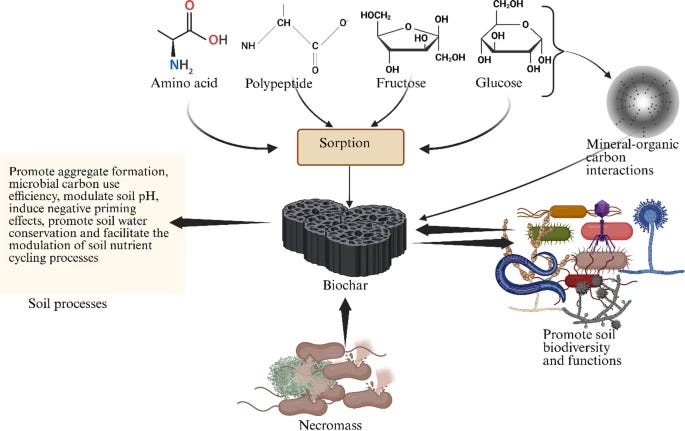
Biochar is the exception to this pattern. The aromatic carbon structures formed during pyrolysis resist decomposition not because they are protected from microbes but because the molecules themselves are chemically stable. The carbon persists on timescales of centuries to millennia. A 2025 PNAS analysis of 438 studies and 3,229 observations found that long-term annual biochar application increased soil organic carbon by more than 50%, reduced methane emissions by 13%, and reduced nitrous oxide emissions by 21%. These effects accumulate over time and do not reverse if management changes. Biochar can also slow the decomposition of native soil organic carbon (a phenomenon called negative priming) building it up by an average of 4% by protecting existing organic matter inside aggregates and on biochar surfaces.
Cover cropping and adaptive grazing build soil organic carbon at rates of roughly 0.3 to 1.0 Mg C/ha/yr, partly as plant residues still breaking down and partly as the more durable mineral-bound fraction. Both forms require continued biological inputs to maintain. These practices also produce benefits biochar alone cannot replace — aggregate stability, water infiltration, biological diversity, in-season nutrient cycling. Biochar bypasses this biological pathway entirely. Its carbon enters the stable fraction directly at the moment of application. The carbon arrives stable and stays stable, but the per-tonne cost is high, and whether biochar genuinely removes carbon depends on whether the feedstock would otherwise have decomposed to CO₂.
Three implications follow. Biochar's carbon claim holds up only when the feedstock is genuine waste biomass — material that would otherwise decompose to CO₂ within months — and when pyrolysis recovers heat that displaces fossil fuel use elsewhere. Biochar and biological soil-building practices are complementary rather than substitutes. Co-composted biochar develops CEC faster, integrates into aggregates more rapidly, and supports the microbial communities responsible for MAOM formation, precisely the pattern visible in the original terra preta. And the carbon math should not drive biochar decisions on most farms. Where biochar earns its place agronomically, the carbon is a meaningful co-benefit. Where it does not, the carbon claim alone rarely justifies the investment, and the same dollars typically produce more durable soil improvement when invested in biological practices.
An Integrated Approach
The terra preta legacy was not built by single applications. It emerged from centuries of integrated management combining charcoal with bone meal, organic refuse, manure, and continuous occupation, supported by an agroforestry system that surrounded the settlements themselves. The most successful modern biochar systems approach the same integration — charcoal as one component within a broader regenerative program rather than a standalone amendment. The technology earns its place in that context. Applied as a one-time additive on inappropriate soils at insufficient rates, it produces the unimpressive trial record it has accumulated. Used where the soil constraint matches biochar’s specific properties, charged with biology before application, and integrated with the practices that build mineral-associated organic matter, it remains one of the few interventions in modern agriculture that can plausibly leave a soil record legible centuries from now.
References:
Sombroek, W. G. Amazon Soils: A Reconnaissance of the Soils of the Brazilian Amazon Region. Wageningen: Centre for Agricultural Publications and Documentation, 1966.
Maezumi, S. Y., Alves, D., Robinson, M., et al. “The legacy of 4,500 years of polyculture agroforestry in the eastern Amazon.” Nature Plants 4 (2018): 540–547. https://doi.org/10.1038/s41477-018-0205-y
Glaser, B., and Lehr, V.-I. “Biochar effects on phosphorus availability in agricultural soils: A meta-analysis.” Scientific Reports 9 (2019): 9338. https://doi.org/10.1038/s41598-019-45693-z
Hamdy, A. E., et al. “Improving leaf chemical composition, yield, and fruit quality of Valencia orange trees through biochar soil application.” Scientific Reports 16 (2026): 3256. https://doi.org/10.1038/s41598-025-34779-6
International Biochar Initiative. Standardized Product Definition and Product Testing Guidelines for Biochar That Is Used in Soil (IBI Biochar Standards), v2.1, 2015. https://biochar-international.org
Bach, M., Wilske, B., and Breuer, L. “Current economic obstacles to biochar use in agriculture and climate change mitigation.” Carbon Management 7, no. 3–4 (2016). https://doi.org/10.1080/17583004.2016.1213608
Laird, D. A. “Biochar Is Not a Miracle Cure, But It Does Have Value.” AgWeb, 2020. https://www.agweb.com/news/crops/corn/biochar-not-miracle-cure-it-does-have-value
Poeplau, C., and Don, A. “Carbon sequestration in agricultural soils via cultivation of cover crops – A meta-analysis.” Agriculture, Ecosystems & Environment 200 (2015): 33–41. https://doi.org/10.1016/j.agee.2014.10.024
Jian, J., Du, X., Reiter, M. S., and Stewart, R. D. “A meta-analysis of global cropland soil carbon changes due to cover cropping.” Soil Biology & Biochemistry 143 (2020): 107735. https://doi.org/10.1016/j.soilbio.2020.107735
Lehmann, J., and Kleber, M. “The contentious nature of soil organic matter.” Nature 528, no. 7580 (2015): 60–68. https://doi.org/10.1038/nature16069
Yan, X., Xia, L., et al. “Sustained benefits of long-term biochar application for food security and climate change mitigation.” Proceedings of the National Academy of Sciences 122 (2025). https://doi.org/10.1073/pnas.2509237122
Wang, J., Xiong, Z., and Kuzyakov, Y. “Biochar stability in soil: meta-analysis of decomposition and priming effects.” GCB Bioenergy 8, no. 3 (2016): 512–523. https://doi.org/10.1111/gcbb.12266
One notable aspect of the whole biochar craze was the endless fascination for lost ancient secrets from the South American Terra Preta, coupled with complete disinterest in the similar African black earths being actively produced and managed on the other side of the Atlantic, by real living people who have no problem telling you how they do it. Says a lot about how virality works.
difficult to parse. i have a bag of biochar from a missouri producer. i drove from nevada to mo this past may to meet him and hear from his mouth how this might help me in the garden (caliche, sand and clay soil now integrated compost and worm castings. still building soil) so its difficult to know how biochar actually works in the desert. mine is currently curing in a ten to one liquid of water and urine.